
Coaching Together, Playing to Win
The fun part of pickleball is that many times there are different formulas to solve an equation. The reality is we both could be right at times, and we both can be wrong at times, depending on the circumstance. The harder challenge is when we're playing together and we each have our own thoughts on how to win a specific game.
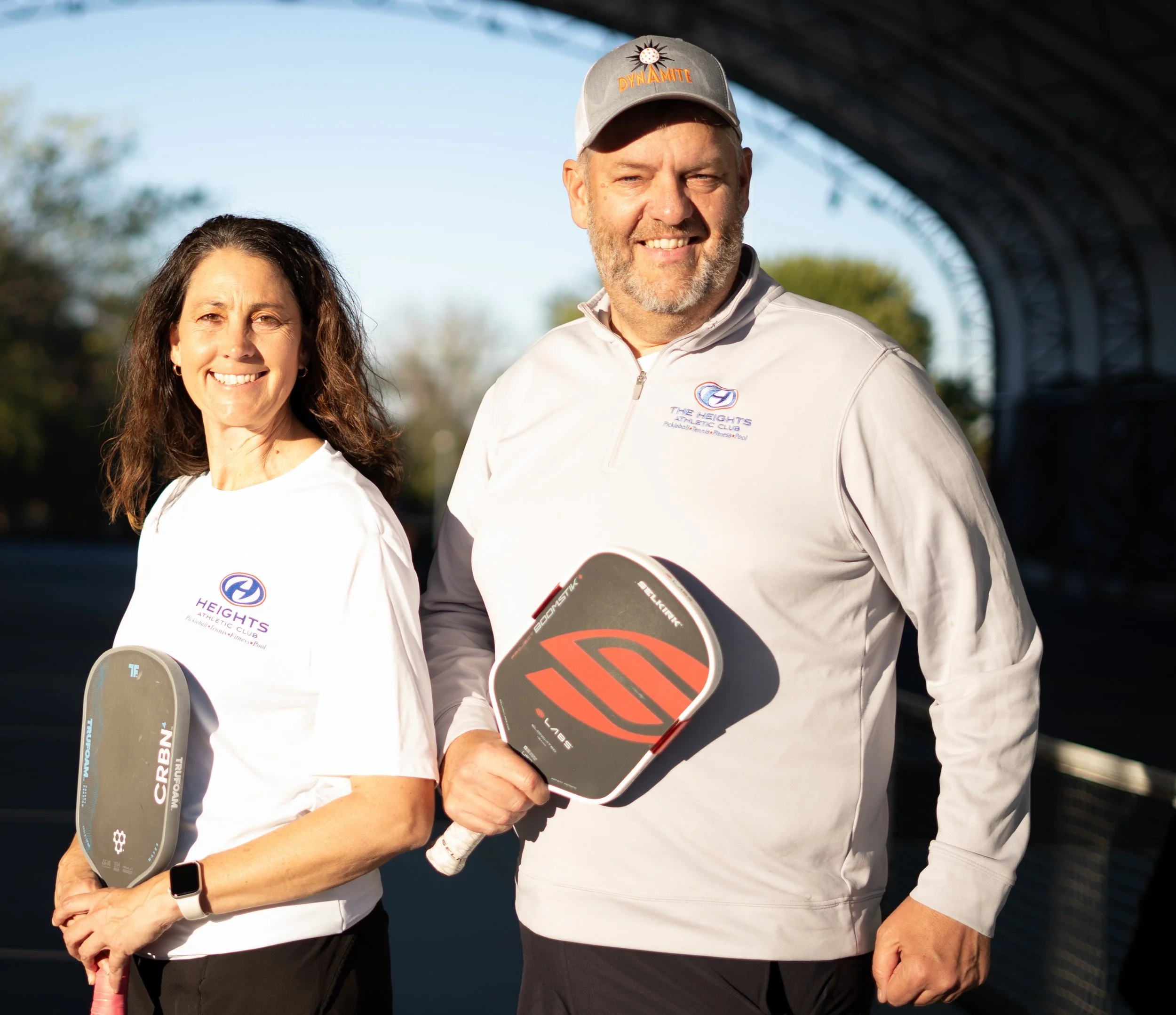
With Picklebilly Travel, I am blessed to work with amazing, talented coaches. Here's a short interview with Dave and Tracy Wilcox. Enjoy!
- Janice Mundee
Q: Have you ever disagreed about how to coach a student, and how did you work it out?
Dave: Of course. The fun part of pickleball is that many times there are different formulas to solve an equation. The reality is we both could be right at times, and we both can be wrong at times, depending on the circumstance. The harder challenge is when we're playing together and we each have our own thoughts on how to win a specific game.
Tracy: Yes, absolutely. Dave and I at times see the game differently, and our different approaches can conflict. For example, he's adamant that the partner of the returner should track the ball behind them to help call out balls. I believe we shouldn't track the ball and should keep our eyes forward. In the end, both are right and both are wrong. Pickleball has different ways of doing things, and you get to choose the approach that's best for you.
Q: I am sure your game and your coaching are always evolving. What is something new you're delighted to be showing your students?
Dave: My most recent "aha" moment is the drip shot. The better and meaner my serve, the more often I get to put it into place. I use this shot more in the senior division, since 50-year-olds don't get up to the net as fast as the youngsters.
Tracy: I'm working on more of a baby arc, landing shallow in the kitchen on my drop, reset, and dink. Adding this shape to my shots has changed the type of ball I hit, and I'm missing less into the net.
Q: Dave, what in your background led you to becoming a coach?
Dave: I have a bachelor's degree in recreational sports, with an emphasis in coaching, and a master's in educational leadership. I use both every day running a club, working with staff, and coaching. I also coached all my kids' sports growing up, and was a basketball and football official.
Q: Tracy, what in your background led you to becoming a coach?
Tracy: I was a highly competitive athlete growing up, playing on multiple club travel teams in soccer and basketball. Coaching was the next logical step. Since college I've coached youth sports, and dedicated most of my time to coaching my children's sports as they grew up. When pickleball came into our lives, it was an easy transition into coaching pickleball.
Q: How do you keep pickleball from taking over every conversation at home?
Dave: This is a great question, and one that takes real effort. We're involved in our church life and Homegroup, we have seven kids and their interests, and we both love the Broncos, along with the Olympics, the World Cup, and other sports. We also watch shows on Apple TV and Netflix.
Tracy: It's almost impossible, because when we're not talking about pickleball we're usually talking about our pickleball businesses. We have to intentionally set aside dedicated times to put down everything pickleball. The next big conversation is usually about our kids.
Q: What does a normal week look like for the two of you — teaching, playing, running a life together?
Dave: Our new normal while living in Texas has been spent with a lot of time during the day working on marketing and building up our programming for nighttime, while also trying to get traction on daytime pickleball. We also play in higher-level tournaments across Texas about two to three times a month. We've also begun teaching at a retirement community about 40 minutes from our house called Sun City, which we've really enjoyed.
Tracy: We're still trying to find our new normal. I spend a good portion of my mornings in the office working on marketing and club events, and problem-solving the many aspects of running a club. I spend my afternoons and evenings teaching and playing.
Q: If you had to pick a walk-up song for each other before a match, what would you choose?
Dave: I'm a big Tyrone Wells fan, and he has a song called "Play to Win." Or really anything from Jock Jams.
Tracy: I'd pick Alicia Keys' "Girl on Fire," or Larceny's "Another Level," or "Play to Win."
Dave and Tracy own Heights Athletic Club and Dynamite Pickleball, both in Texas. They coach players of all ages and skill levels through academies, leagues, clinics, retreats, and training programs. Tracy's tagline: "Your best pickleball starts in your head."
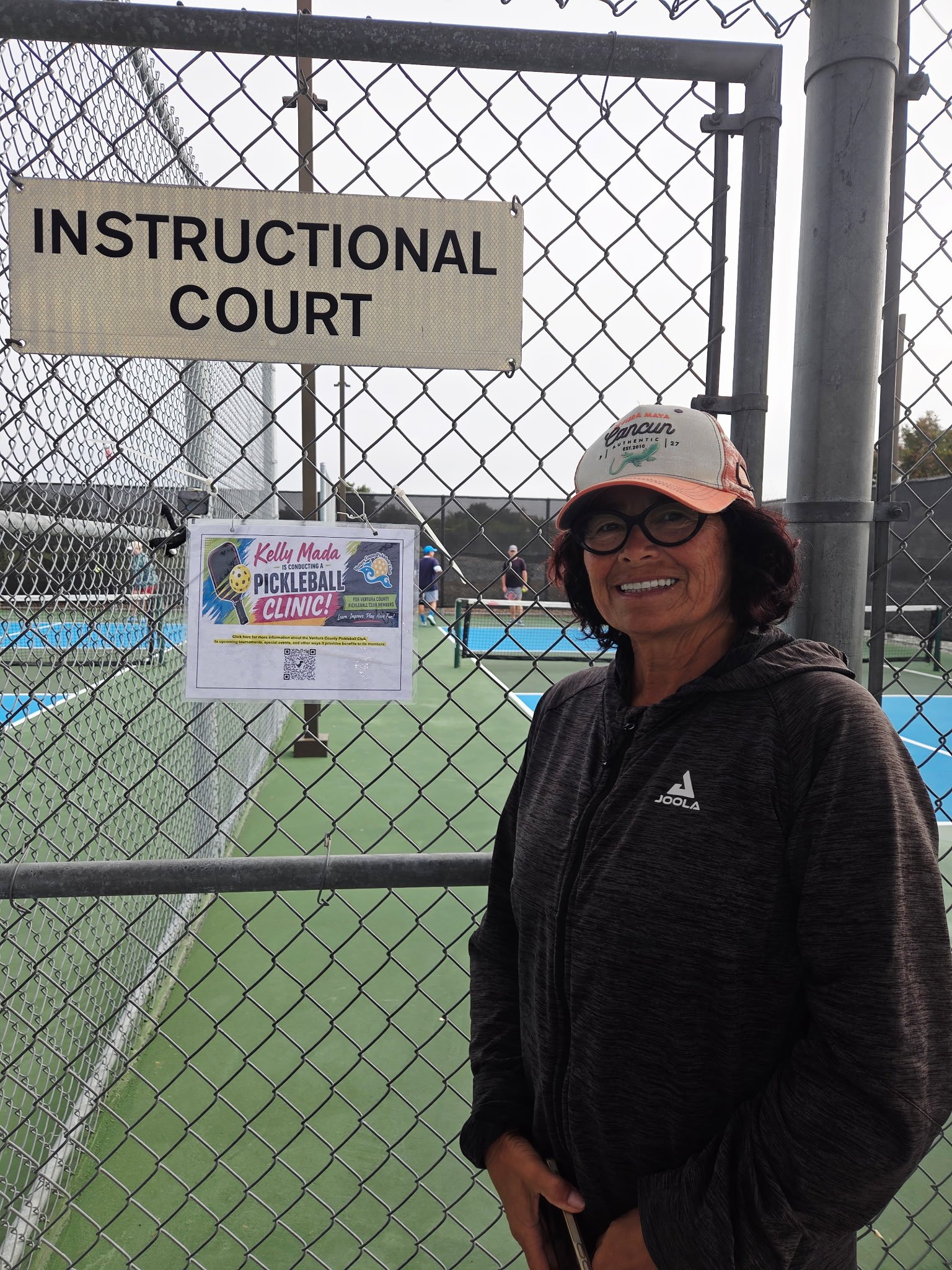
Act Like a Pro—a conversation with Coach Kelly Mada
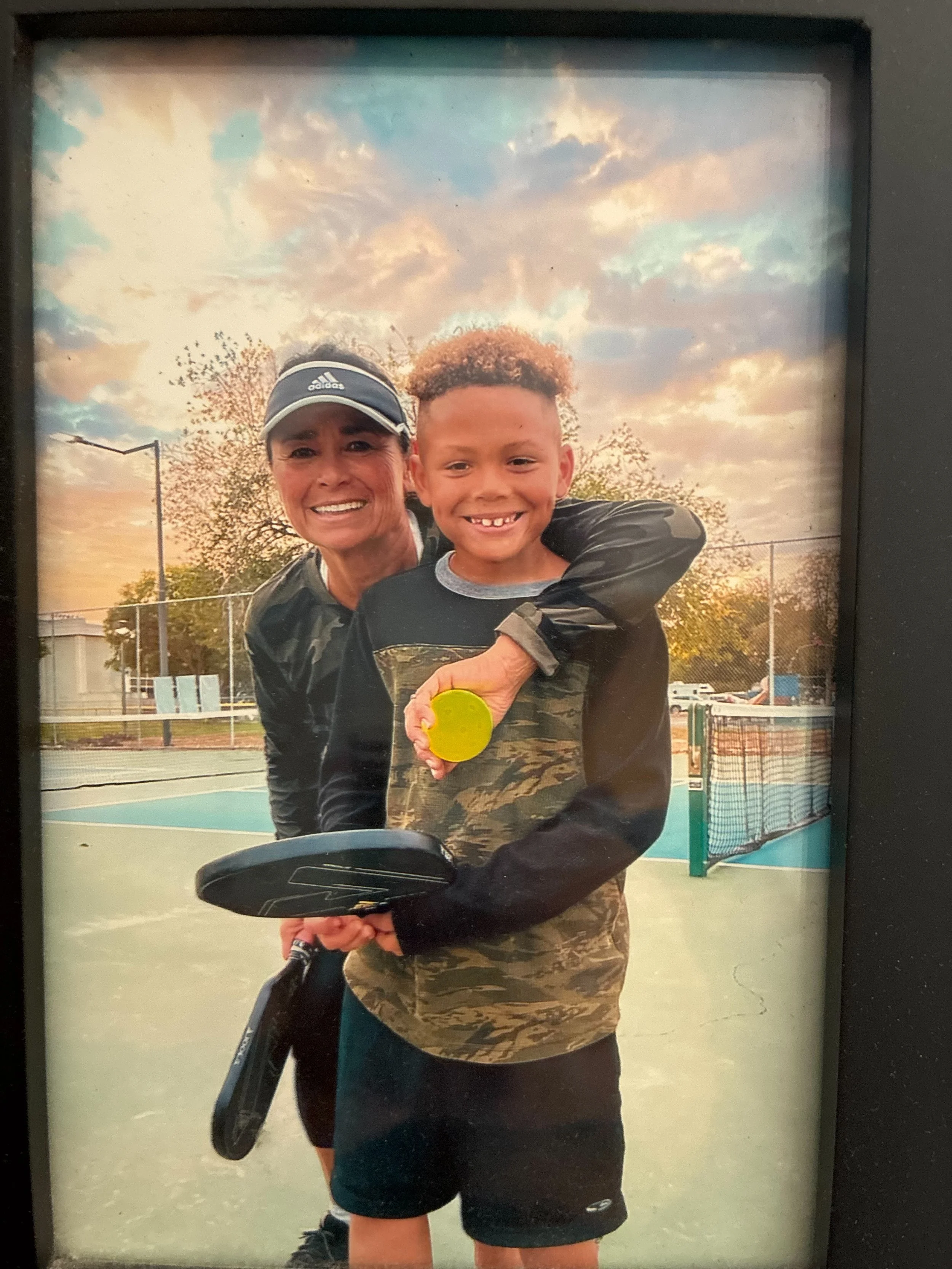
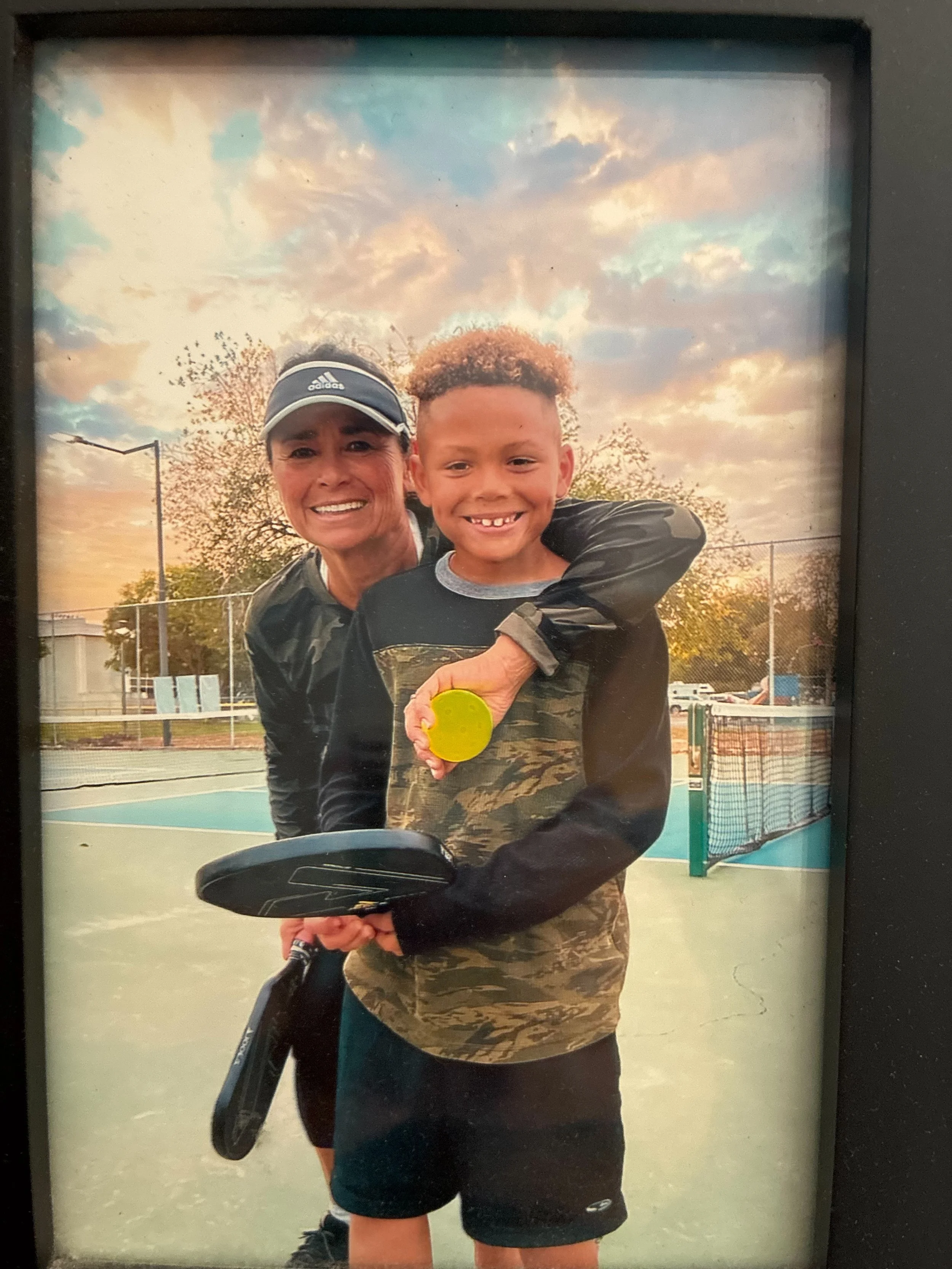
I don't compare myself to other players on the court anymore. This is something I had to work on over the years. After I make a mistake, I take a deep breath. I try to make sure I don't have any negative body language or talk badly to myself. Mistakes happen and the game is too short to dwell on them.
What I learned from Jill Braverman is if I say this mantra in my head — act like a pro, play like a pro — it gets me re-centered every time.
Coach Q&A
Act Like a Pro
A Conversation With Kelly Mada
While setting up pickleball trips for Picklebilly Travel, I have the good fortune to meet and work with amazing coaches, like Kelly Mada. :)
ME: You have such a generous way of connecting people and opening doors for others. Where do you think that kind of strength and generosity comes from?
KELLY: I've always loved to make others happy. I'm not sure where that comes from, but I know at an early age I was involved with my local church. I'd go to Sunday school every week. The bus would pick us up in our neighborhood and all of the kids in the neighborhood would go to church.
I also played team sports since I was in 4th grade. I learned to work with others. I learned discipline, consistency, responsibility. How to show up even when I didn't want to. Working with teammates you learn to support and respect one another.
As I got older, and started my career in sales, I learned how to provide a solution to problems. I learned how to network. I was helping others each and every day. During this time I also changed my life path, which taught me how to share my experience, strength, and hope so that others could experience the same. I learned to pay it forward.
ME: Can you talk about your evolution as a player — from when you first started playing pickleball to where you are now? What has that journey looked like for you?
I first started playing seven years ago with a $10 paper paddle from Parks and Rec. Some friends introduced me. From day one I never stopped playing. I am very competitive, and I found out that pickleball had tournaments and I jumped on it. Remember, I had played sports my entire life, so I was used to competing.
I had many people on the courts teach me about the game. I made new friends. I had found a new passion. I knew in order for me to be competitive I had to get better, so I reached out to a local pro in Santa Barbara, and she taught me how to do a top spin dink. I took many private lessons with her. I also watched a lot of pro pickleball and started reaching out to other pros to learn from them as well. My Santa Barbara coach, Lauren Stratman, had moved to Tennessee.
When Lauren moved I started working with Jessie Irvine. She taught me so many things as well. I also found a group of friends who were on the same trajectory, so we would drill and play together. Then Covid hit. I purchased a ball machine and continued to work on my drops, top spin dinks, and court movement.
When Covid restrictions opened up, myself and three others worked with Dayne Gingrich for two years, twice a month. That elevated all of our games.
ME: What do you love most about coaching, and what do you think makes you effective as a coach?
KELLY: I love helping others. I love it when I see students execute the shots or correct the footwork that we've worked on. It's truly the student who makes this all happen. I am just passing along the information that I learned from my coaches and what works for me. What makes me effective as a coach is being able to identify the struggles a player is having and working on making the correction.
ME: What is one skill or part of your own game that you're actively working on right now?
KELLY: I'm working on having soft hands with all of my shots. I'm working on getting away from the death grip.
ME: Pickleball can be such a mental game. How do you stay focused, reset after mistakes, and keep yourself on track during competitive play?
KELLY: First thing is I don't compare myself to other players on the court anymore. This is something I had to work on over the years. After I make a mistake, I take a deep breath. I try to make sure I don't have any negative body language or talk badly to myself. Mistakes happen and the game is too short to dwell on them.
What I learned from Jill Braverman is if I say this mantra in my head — act like a pro, play like a pro — it gets me re-centered every time.
The Player, the Coach, the Perspective: Scott Fliegelman
When you’re coaching, what are you noticing first that most players don’t see themselves?
Strike zone management is a huge issue, and mostly the fault of poor footwork, especially the lack of a split-step or even a brief pause. Without that critical skill, players are not composed and ready to raise their antennae in order to gather info from the opponent's’ inbound shot, their momentum is often going in the wrong direction, while springs (knees) are not loaded and ready to move to the ball. Net, net, too many players are too frequently not “swinging at strikes”, forcing them to use too much wrist or other poor techniques, losing a ton of accuracy, popping balls up, and making a lot of unforced errors.
Most players think getting better at pickleball means hitting harder or playing more games.
That’s not what Scott Fliegelman sees.
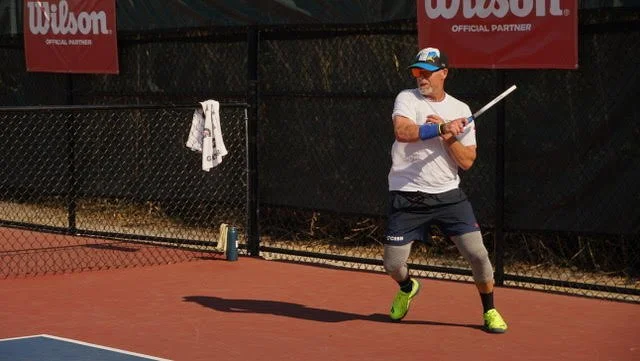
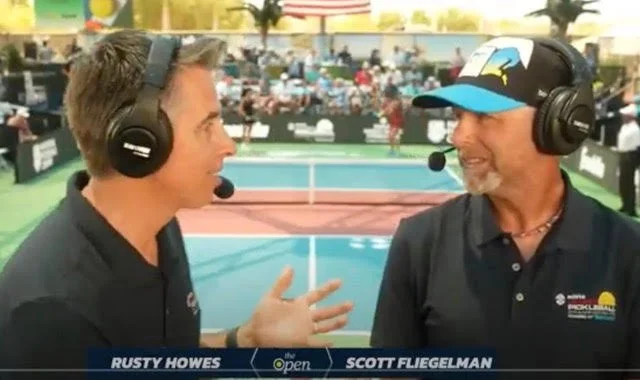
I reached out to Scott—a coach and Senior Pro who’s worked with thousands of players from beginner to pro—and what stands out isn’t just his experience. It’s how he sees the game and the path that shaped him.
Simple ideas—but not easy ones. The kind that stick with you long after you hear them.
Want more like this?
👉 Join Picklebilly here JOIN HERE
You’ve done so much across different sports—what was it like growing up, and can you point to anything early on that helped shape your competitiveness?
I played almost every sport as a kid, but my very best memories were of my Dad coaching me in basketball from around age 8-11. He wore a suit, because he was often coming from work, but also because that’s what the top coaches of that era wore on the sidelines… I thought he was so cool! As tennis eventually took over for me and squeezed out time for other sports, my Dad took it in stride, and often would “coach” me from the sidelines during breaks in the action. He had zero experience with tennis, so I mostly just listened politely and thanked him for the advice, but every now and then he’d come up with a winning strategy, and we’d celebrate it the whole car ride home. He passed away before I started pickleball, which is a huge bummer, as I know he’d love to sit court side for all my big matches and share sage observations.
When you’re working out, do you listen to music? What are a few go-to songs or artists on your playlist?
I almost always have music playing when practicing, teaching, or working out… I get a little freaked out if it is too silent! 80’s is a solid go to for me, not surprisingly given my age, but I also dig classic rock and seem to play my best with Scorpions, G&R, or Zeppelin playing loud on the speakers at Boulder Pickleball!
What do you think separates players who improve quickly from those who stay stuck?
Racket sports players > stick n’ ball athletes > avid/ active/ athletes, in that order, generally progress faster than those without these experience sets. That said, some without any racket sport experience have the advantage of not needing to “unlearn” many habits, and often embrace the critical elements of the soft game sooner, compared with most converting tennis and racketball players.
What’s one mindset shift that changed your own game the most?
I’ve learned the value of daily “touches”, even at the 5.5+ level. It wasn’t by design, rather due to limited time, courtesy of my job as a pickleball facility owner and coach, I lack the ability to practice or play much with others my level… we’re talking like 2-3 opportunities per month! A very pleasant surprise, however, was the revelation that getting 3-4 hours daily of basic “touches”, while teaching players 2.5 - 4.5, has allowed me to continue to find incremental improvement, especially with the soft game. That was definitely not the case with tennis!
When you’re coaching, what are you noticing first that most players don’t see themselves?
Strike zone management is a huge issue, and mostly the fault of poor footwork, especially the lack of a split-step or even a brief pause. Without that critical skill, players are not composed and ready to raise their antennae in order to gather info from the opponent's’ inbound shot, their momentum is often going in the wrong direction, while springs (knees) are not loaded and ready to move to the ball. Net, net, too many players are too frequently not “swinging at strikes”, forcing them to use too much wrist or other poor techniques, losing a ton of accuracy, popping balls up, and making a lot of unforced errors.
What do you think most people misunderstand about high-level pickleball?
Speaking about Senior Pro pickleball, of which I have the most direct knowledge, it is helpful, if not a bit demoralizing for amateurs, to learn that 95% or more of the top players come with very high level tennis experience. Thankfully, with the young pros, we are starting to see top players coming up with pickleball specific training, and either minimal or no tennis experience at all. Hayden Patriquin is the best example and there are more on their way.
What still excites you about the game today?
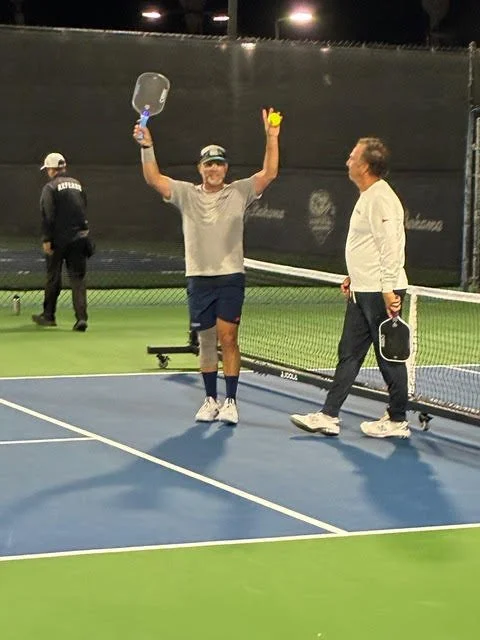
Hmmm… my honest answer is the growing impact I’m able to have as a coach. Locally, I’m grateful for the chance to have worked in person with nearly 5,000 players from total newbie to pro level. Over the past few years, I’ve been fortunate to scale my reach through social media, including audio and video podcasts, YouTube videos, and IG and FB short form instruction and tips. I’m still excited to compete, but slightly less so compared with coaching. That said, I “get” to compete in the 60+ category next year, which has me fired up, including a return to playing singles, now that I can play against kids my own age.
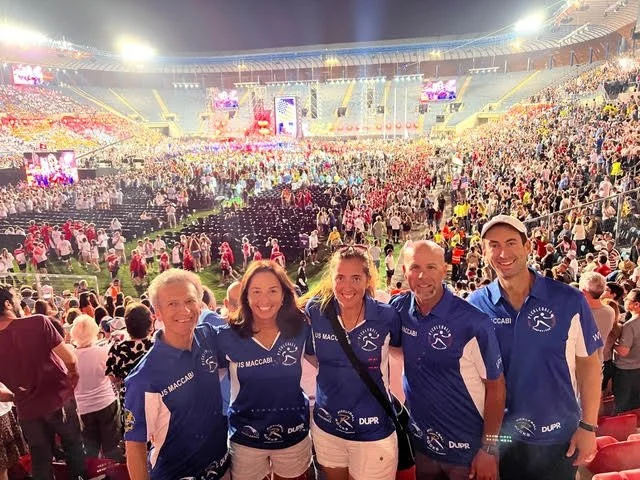
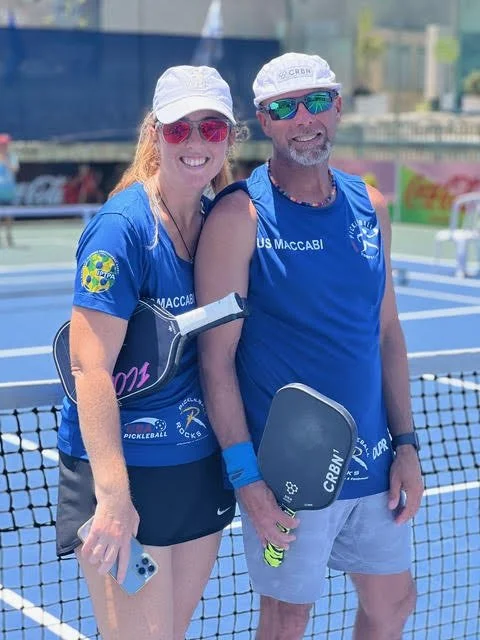
Some of our TEAM USA delegation at the 24th Maccabiah Games Opening Ceremonies in Jerusalem. Pickleball was an exhibition sport in 2022 and will be a medal event this summer!
You’ve competed in the Maccabiah Games in Israel and completed multiple triathlons—how has your broader athletic background shaped the way you approach pickleball and coaching?
I was fortunate to be a part of a group of Americans who went to Israel nearly four years ago to help promote pickleball. Now, the sport has really taken off in that country, and pickleball has been included in the 25th Maccabiah Games, scheduled for this July. I am really hoping the Games will go on with robust participation from the expected 80+ countries scheduled to send athletes, and that I’ll be able to represent the USA, along with my teammates from around the country.
My diverse athletic background includes college and pro tennis, pro snowboarder, elite age group triathlon, cycling, and running, and pro pickleball since 2019. I feel that collective experience contributes to my success as a pickleball pro in myriad ways, but perhaps most of all in acknowledging that “pressure is a privilege”. When I get butterflies in my belly before a big match on center court, I know that those are familiar and welcome sensations, which have led to success in the past. I coined a little phrase to help deal with those butterflies- “When pre-recorded for success, just press play”… of course, if we haven’t done the preparation, then the “music” doesn’t come out sounding quite as sweet as we would like, but that just serves to motivate us to better train the next time!
If this resonated, you’ll like what’s coming next.
I share:
Coaching insights from top players
Behind-the-scenes on how these trips actually come together
First access to new retreats (before they fill)
👉 Join the Picklebilly list here: www.picklebilly.com/join
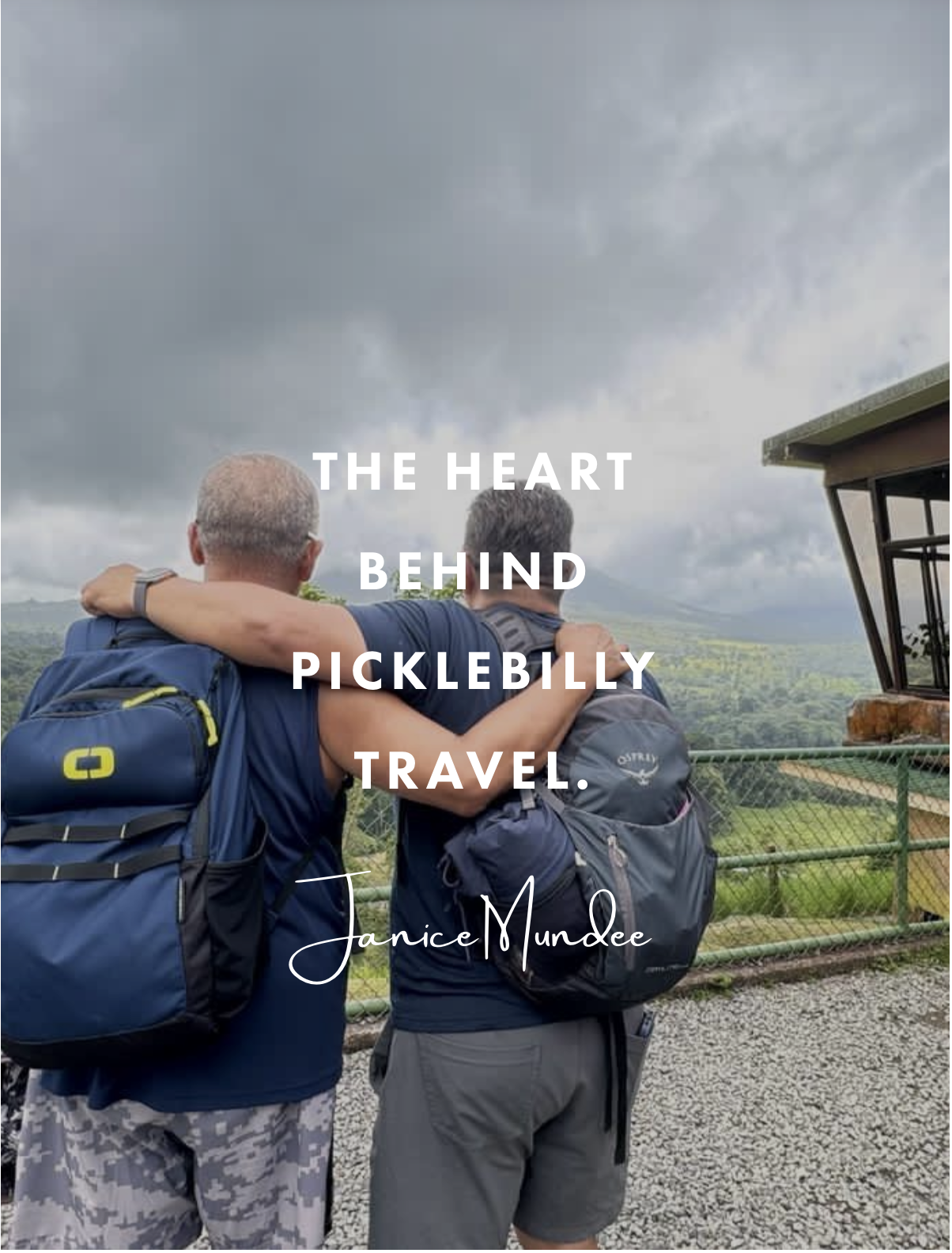
The Heart Behind Picklebilly Travel
It didn’t start the way you’d expect….
Five years ago, I was retired when someone approached me to curate a pickleball trip.
I said yes.
I gathered a group of friends.
And honestly… it wasn’t very good.
We stayed in tiny cabins that felt like they were designed for kids. Some people were sharing tight spaces. The food wasn’t enough for a group playing hours of pickleball every day—we actually had to ask for more. It just missed the mark in a lot of ways.
And here’s the surprising part…
I still remember that trip with a full heart.
Because what did work had nothing to do with the cabins or the meals.
It was the moments.
Singing together on the bus.
Taking tequila shots.
Sliding into the water and laughing like kids.
Sitting together and talking—really talking.
That’s what stayed.
That trip taught me something I’ve never forgotten:
The magic isn’t in the logistics. It’s in the connection.
Now, fast forward to today.
Our recent trips look very different on the surface.
Private suites.
Beautiful villas.
A private chef.
Thoughtful coaching and curated experiences.
All of that matters. It elevates the experience.
But it’s still not the heart of it.
The heart is what happens in between.
The teasing after a great rally.
The laughter in the pool after a long day of play.
The shared rides to dinner, to the beach, to explore somewhere new.
The quiet moments—like sitting together, or even meditating side by side.
That’s the part I care about most.
That’s the part I’m always chasing.
And I say “chasing” because you can’t force it. You can only create the space for it… and then let it happen.
But somehow—it always does.
At the end of every trip, people ask the same question:
“Where are we going next?”
Not because of the villa.
Not because of the itinerary.
Because of how they felt.
We’re living in a time where it’s easy to feel disconnected.
We’re on our phones. We’re busy. We’re pulled in a hundred directions.
But people are hungry for real connection.
And when you put the right group together in the right environment… something special happens.
That’s what Picklebilly Travel is really about.
Not just where we go.
But how we feel when we’re there—together.
Janice Mundee